
Business
Shettima to states-Don’t rely on FG for electricity
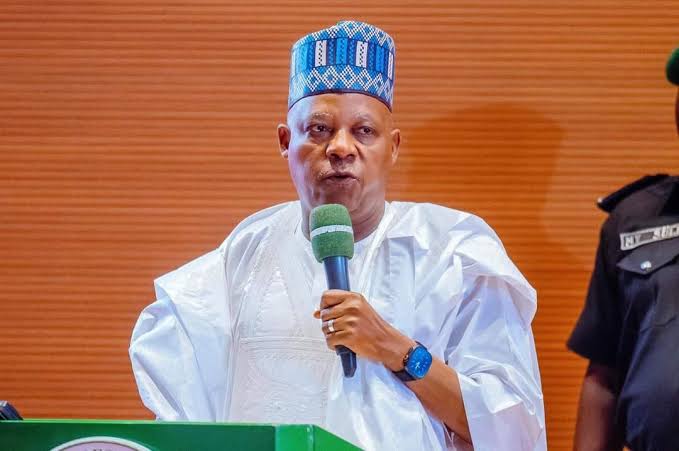
Vice-President Kashim Shettima has charged state governments to stop relying on the Federal Government to resolve their electricity challenges, urging them to establish functional power markets and attract private investment to improve supply.
Shettima said Nigeria’s vision to build a competitive industrial economy would remain constrained unless electricity reforms delivered reliable power to businesses, households and public institutions.
He spoke on Wednesday while declaring open the National Stakeholders’ Workshop on the Electricity Act 2023 at the Banquet Hall of the State House, Abuja.
Deputy Chief of Staff to the President, Senator Ibrahim Hassan Hadejia, who represented the vice-president said the law gave states the opportunity to develop and regulate electricity markets within their jurisdictions, allowing them to design solutions suited to local needs and available resources.
Shettima identified solar energy potential in Sokoto, Borno and Katsina, gas resources in Delta, Rivers and Bayelsa, and hydroelectric opportunities in Niger and Kebbi as resources states could exploit to expand electricity supply.
He urged state governments to turn these advantages into investments that would support agriculture, manufacturing, healthcare and education.
The vice-president warned, however, that passing legislation alone would not improve electricity supply, urging states that had yet to establish regulatory institutions to begin the process without delay.
“Legislation cannot implement itself. States yet to act must begin their legislative and institutional preparations promptly,” he said.
He also proposed a National Electricity Reform Peer Review and Implementation Framework involving the Nigerian Electricity Regulatory Commission (NERC), Federal Ministry of Power, Nigeria Governors’ Forum and state electricity regulators.
According to him, the voluntary framework would enable states to share experiences, strengthen regulatory capacity and assess progress in investment, consumer protection, electricity access and market development.
“No state needs to purchase with failure the knowledge another state has already acquired,” Shettima said.
He stressed that private investment was essential to meeting the country’s electricity infrastructure needs, noting that government funding alone could not finance the required transformation.
“Government cannot finance this transformation from the treasury alone; private capital must arrive with technology and expertise,” he said.
Shettima added that transparent licensing, predictable regulation, commercially viable markets and effective dispute resolution would help build investor confidence.
He also called for stronger consumer protection against arbitrary billing, poor service and unfair commercial practices, insisting that electricity operators must be held accountable for the quality of service they provide.
Author Profile

Latest entries
 FeaturesNovember 20, 2026For The Records: DELIVERING TODAY, ENERGIZING TOMORROW
 Metro/CrimeNovember 20, 2026Crisis: Fountain of Life Church announces Sunday service, denies being sealed
 NewsNovember 20, 2026‘Tinubu may win only two states in 2027’
 NewsNovember 20, 2026INEC under attack for refusing to register AAP





For The Records: DELIVERING TODAY, ENERGIZING TOMORROW

Crisis: Fountain of Life Church announces Sunday service, denies being sealed

‘Tinubu may win only two states in 2027’

APC dismisses Ikonne’s claim to Abia South Senatorial ticket

Governor Fubara hosts Adventist World Church President, pledges support for proposed South-south Union Conference

APC final list: Govs, heavyweight senators, others axed out
-
 News6 months ago
APC dismisses Ikonne’s claim to Abia South Senatorial ticket
-
 Events5 months ago
Governor Fubara hosts Adventist World Church President, pledges support for proposed South-south Union Conference
-
 Features5 months ago
APC final list: Govs, heavyweight senators, others axed out
-

 Events5 months ago
Tears, tributes as Abia government, Nollywood bid farewell to Alex Ekubo
-
 Metro/Crime6 months ago
Nigeria’s bleeding, declare nat’l security emergency – Northern elders tell Tinubu
-
 News5 months ago
2027 election: Court nullifies NDC registration
-

 Metro/Crime5 months ago
NYSC blacklists 3 LGAs Kebbi, to relocate orientation camp
-

 News1 month ago
Abia Governor, Otti flags off Abia Tertiary Education Sports Fiesta with Lighting of Torch of Unity